
United Energy Egypt Delivers Measurable Sustainability Impact Across Education, Agriculture, and Industry through the Green Transition Project
United Energy Egypt (UEE), through its commitment to advancing sustainable development and community empowerment, announced the successful implementation of the second phase of The Green Transition (TGT II) project, delivering measurable social, environmental, and economic impact across Borg El Arab and Wadi El Natrun in partnership with YTG
The project was designed to accelerate the adoption of sustainable practices in education, agriculture, and industry by equipping local communities with the knowledge, technologies, and resources needed to drive long-term transformation
As part of the project, more than 65 educators from technical schools received specialized training in sustainability and circular economy concepts, enabling them to integrate green skills into their teaching practices. These efforts have already reached over 1,500 students, helping prepare a new generation for emerging opportunities in the green economy
Beyond education, the initiative engaged more than 70 farmers, factory workers, and entrepreneurs to identify barriers to sustainable growth and co-create practical solutions tailored to local needs
A major component of the project focused on renewable energy adoption in agriculture. Three solar-powered systems, including two fixed installations, were deployed to support 11 landowners in Wadi El Natrun. The intervention enabled participating farms to significantly reduce operating costs, eliminate dependence on conventional electricity sources after payback, and decrease maintenance requirements by up to 60%
In one featured farm, operations became fully powered by solar energy, resulting in zero electricity costs, zero energy-related emissions, a 33% reduction in power load, and substantial maintenance savings
The project also introduced circular economy solutions that transformed agricultural waste into valuable animal feed while supporting cleaner production practices within local industries
Industrial interventions generated notable economic and environmental returns. In one facility, upgrading production systems reduced annual energy consumption from 219,000 kWh to 197,100 kWh and generated annual savings exceeding EGP 54,000. Another initiative focused on localizing production reduced carbon emissions per container by more than 80%, lowered fuel consumption dramatically, and delivered cost savings of approximately 42% compared to imported alternatives
Additionally, the introduction of advanced manufacturing equipment doubled production output from 26,666 to 53,332 units per 12-hour shift, while simultaneously improving workplace safety and reducing manual handling requirements
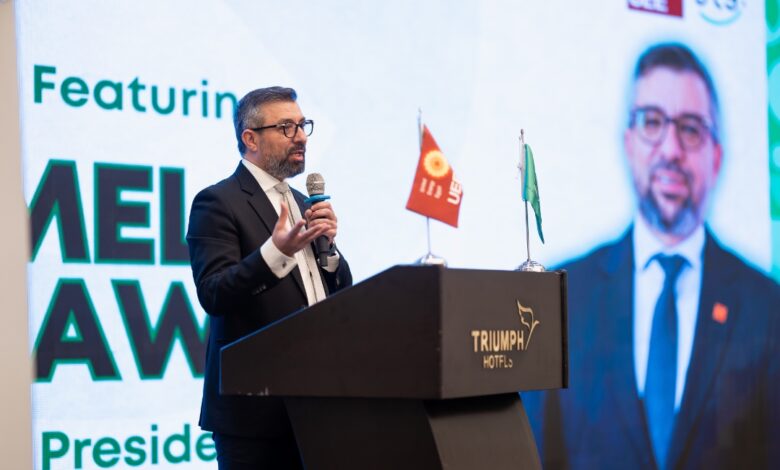
“Through The Green Transition II project, we have demonstrated that sustainability is not only an environmental imperative but also a driver of economic opportunity and community resilience,” said Eng. Kamel Al Sawi, Regional President Africa “. By investing in people, technology, and practical solutions, we are helping create a model for sustainable development that delivers real and measurable impact on the ground
The results of the project highlight the potential of integrated approaches that connect education, renewable energy, circular economy practices, and industrial innovation to create lasting value for communities while contributing to Egypt’s broader sustainable development goals