

The competition attracted 128 teams from Egypt, Morocco, Tunisia, Indonesia, Nigeria and Jordan, focusing on AI-powered tools for automated testing, API validation and software quality engineering, with all winning positions secured by Egyptian teams.
The Information Technology Industry Development Agency (ITIDA) has concluded its software testing competition, highlighting a new wave of AI-driven innovation in software quality engineering. The event ran alongside the fourth edition of “Software Testing Day”, organized by the Software Engineering Competence Center (SECC)
The competition brought together 128 teams from across universities and industry backgrounds, including participants from Egypt, Morocco, Tunisia, Indonesia, Nigeria, and Jordan — underscoring growing global interest in AI-powered software quality and automated testing systems
At the core of this year’s submissions was a clear shift: AI is no longer a supporting tool in testing workflows, but a core engine for automation, validation, and decision-making
Eighteen teams qualified for the final stage, including five student teams and 13 professional teams, reflecting a high technical standard and diversity of expertise among participants
Egyptian teams secured all winning positions across both categories, with three winning teams selected in each of the student and professional tracks
AI-native testing tools from student teams
Among the standout student projects was QualiaUI, an AI-powered UI testing tool that enables testers to create and run automated tests using natural language. The system reduces manual work and accelerates UI testing cycles by translating plain language inputs into executable test actions
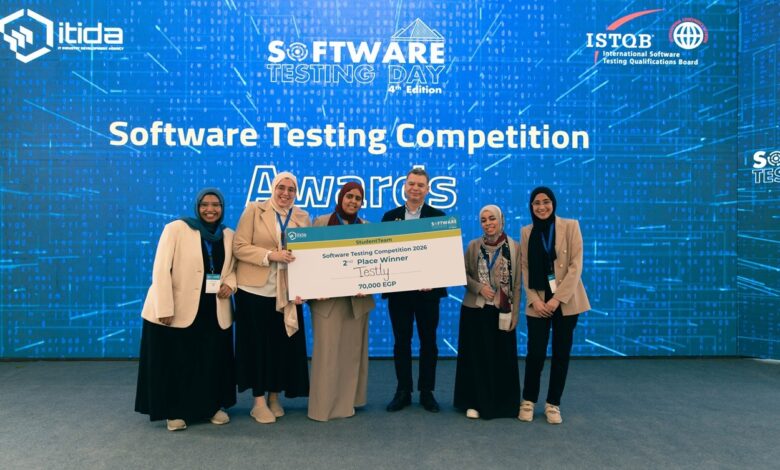
Another finalist, Testly, focused on AI-driven API testing automation by generating and executing test sequences from user stories and APIs. The system validates API execution behavior and produces structured testing reports for developers and QA teams
The third-winning student team, M.H.M, developed AgentJury, an AI system that uses multiple LLM “judges” to evaluate AI applications at each release. It assesses robustness, regression, and failure risk, and automatically generates defect reports. The system adds a continuous QA layer to detect hallucinations, jailbreaks, and regressions without manual test redesign
Enterprise-grade AI automation from professional teams
In the professional category, QA Catalyst developed an application that helps testers manage the QA process from requirements through execution and sprint review. The system reduces manual work while improving testing visibility, coverage, and decision-making across the testing lifecycle
Ostrich Team built a complete end-to-end flow for test case generation and automation scripting for APIs using multiple LLMs, with an architecture designed for scalability and multi-phase deployment across enterprise environments
Meanwhile, QBot is an AI-powered QA assistant designed to accelerate manual QA activities and streamline the software testing life cycle (STLC). It generates key testing artefacts including test plans, test cases, RTMs, bug reports, test execution outputs, usability testing assets, and more, while improving productivity and ensuring data security and confidentiality throughout the process.
“AI is reshaping how we define software quality,” said Ahmed Elzaher, CEO of ITIDA, at the closing ceremony
He noted that the competition reflects the rapid evolution of Egypt’s digital talent landscape, with teams from Egypt and across the Arab region, Africa and Asia participating, and all finalists coming from Egypt
“We are seeing a clear shift in how Egyptian engineers are applying artificial intelligence — not only to automate testing, but to rethink software quality itself through more intelligent and scalable approaches. The competition highlights the depth of innovation emerging from our talent ecosystem and its alignment with global software engineering trends,” Elzaher added.
Global jury, international standards
A 12-member judging panel included international experts from ISTQB, Sogeti (Capgemini Group), GASQ, and SECC, reflecting global standards in software quality engineering
Among them were Joel Oliveira, Chair of Governance at the International Software Testing Qualifications Board (ISTQB) and Head of Quality Assurance at Celfocus in Portugal; Dr Lovlesh Behary, Chair of the ISTQB Marketing Working Group and Chair of the Mauritius Software Testing Qualifications Board (MSTQB); Marcus Seifert, Chief Technology Officer at Sogeti (Capgemini Group, Germany); and Werner Henschelchn, Chief Executive Officer of the Global Association for Software Quality (GASQ), Germany
The initiative, delivered through delivered through SECC under the leadership of Dr. Haitham Hamza, is part of a broader strategy to strengthen digital skills, expand AI capabilities in software engineering, and position Egypt as a competitive hub for global IT and software services